

300-640 Practice Cisco Verified Answers - Pass Your Exams For Sure! [2026]
Valid Way To Pass CCNP Data Center's 300-640 Exam
NEW QUESTION # 10
A Cisco AI infrastructure requires fast convergence after a spine switch failure. Which routing design principle best supports this objective?
- A. Static route redistribution
- B. Single-path forwarding
- C. Layer 2 loop dependency
- D. Equal-cost multipath routing
Answer: D
Explanation:
ECMP provides multiple active forwarding paths and enables rapid failover when a path becomes unavailable. AI environments benefit from resilient high-bandwidth forwarding. Static redistribution slows operational flexibility, while single-path forwarding and Layer 2 dependency reduce scalability and convergence efficiency.
NEW QUESTION # 11
An engineer configures quality of service in the Cisco ACI fabric to connect VAST storage servers. Which combination of attributes must be selected?
- A. Congestion Algorithm: Weighted Random Early Detection (WRED)
Congestion Notification: Disabled - B. Congestion Algorithm: Tail Drop
Congestion Notification: Disabled - C. Congestion Algorithm: Weighted Random Early Detection (WRED)
Congestion Notification: Enabled - D. Congestion Algorithm: Tail Drop
Congestion Notification: Enabled
Answer: C
Explanation:
VAST storage integration in a Cisco ACI fabric requires QoS settings that support lossless, congestion-aware Ethernet behavior. Weighted Random Early Detection with congestion notification enabled allows the fabric to signal congestion early through ECN before buffer exhaustion occurs, helping maintain predictable performance for high-throughput storage traffic.
NEW QUESTION # 12
An engineer notices excessive broadcast traffic inside a legacy AI server VLAN. Which technology should be implemented to reduce flooding and improve scalability?
- A. VXLAN EVPN
- B. RIP
- C. PAT
- D. GRE tunneling
Answer: A
Explanation:
VXLAN EVPN reduces unknown unicast and broadcast flooding by using control-plane learning with BGP EVPN. This improves scalability in modern AI data centers. RIP is outdated for large- scale fabrics, while PAT and GRE tunneling do not address broadcast domain limitations.
NEW QUESTION # 13
Drag and Drop Question
A network engineer is designing congestion management for an AI cluster using RoCEv2 transport. Based on Cisco best practices, the engineer must understand how ECN and PFC work together to provide lossless Ethernet transport. Drag and drop the congestion management mechanisms from the left onto the corresponding descriptions on the right. Not all options are used.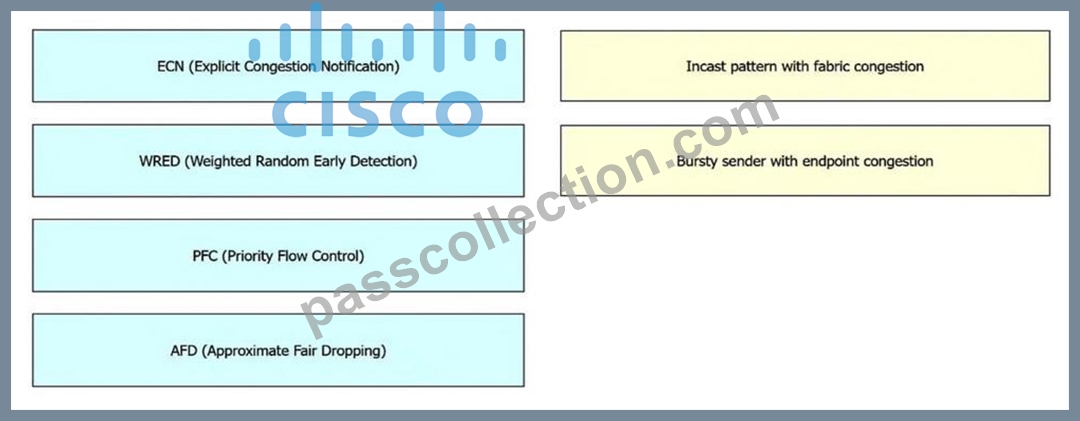
Answer:
Explanation: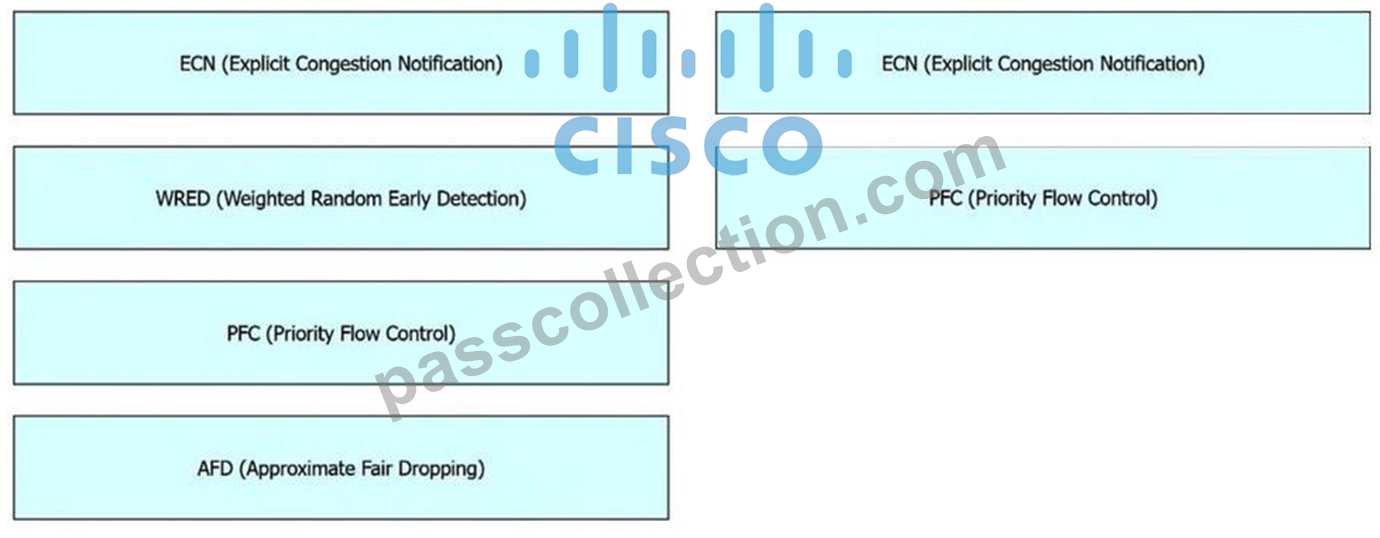
NEW QUESTION # 14
A Cisco AI cluster requires segmentation between multiple research teams sharing the same physical infrastructure. Which solution provides scalable tenant isolation?
- A. Static NAT
- B. Hub-and-spoke WAN
- C. VLAN-only design
- D. VXLAN overlays
Answer: D
Explanation:
VXLAN overlays provide scalable multi-tenant segmentation using large VNI spaces beyond traditional VLAN limitations. AI infrastructures often support many isolated environments simultaneously. VLAN-only designs have scalability constraints, while WAN topologies and NAT do not provide modern data center tenant segmentation.
NEW QUESTION # 15
An engineer configures Cisco Nexus Dashboard Fabric Controller for AI infrastructure automation. The company wants centralized policy management and simplified fabric provisioning across multiple pods. Which capability provides this benefit?
- A. Intent-based fabric automation
- B. Manual CLI consistency checks
- C. Local VLAN switching
- D. Distributed ACL processing
Answer: A
Explanation:
Intent-based fabric automation simplifies deployment and policy consistency across large AI infrastructures. Nexus Dashboard Fabric Controller automates provisioning, validation, and operational management. Distributed ACLs and local VLAN switching are operational features but do not centralize orchestration. Manual CLI verification is error-prone and unsuitable for rapidly scaling AI environments.
NEW QUESTION # 16
A network architect designs a Cisco AI fabric with spine-leaf topology. What is the primary advantage of this architecture for AI training workloads?
- A. Simplified wireless integration
- B. Predictable low-latency east-west traffic
- C. Reduced need for IP addressing
- D. Elimination of routing protocols
Answer: B
Explanation:
AI workloads generate massive east-west traffic between compute nodes. Spine-leaf designs provide predictable latency and scalable bandwidth because each leaf switch maintains equal- cost paths to all spines. Routing protocols are still required, IP addressing remains necessary, and wireless integration is unrelated to AI fabric performance requirements.
NEW QUESTION # 17
What is a purpose of Cisco AI PODs?
- A. to offer a flexible AI infrastructure focused on inferencing workloads with optional training capabilities
- B. to deliver modular AI hardware components that can be integrated with third-party software platforms
- C. to provide a turnkey, full-stack infrastructure for AI training, fine-tuning, and inferencing
- D. to enable AI lifecycle management through cloud-native software with hardware support limited to compute servers
Answer: C
Explanation:
Cisco AI PODs are designed as integrated, validated full-stack infrastructure solutions that combine compute, networking, storage, and management capabilities to support AI training, fine- tuning, and inferencing workloads with faster deployment and operational consistency.
NEW QUESTION # 18
An organization deploys Cisco Nexus switches supporting RoCEv2 traffic. Which QoS behavior is most critical to maintain reliable GPU communication?
- A. Best-effort forwarding
- B. Randomized path selection
- C. Low-latency lossless transport
- D. Strict packet fragmentation
Answer: C
Explanation:
RoCEv2 depends on low-latency and near-lossless Ethernet transport to maintain efficient RDMA communication. Packet drops trigger retransmissions and significantly degrade AI training performance. Best-effort forwarding cannot guarantee delivery quality, while fragmentation and randomized path selection do not address the primary RDMA requirement.
NEW QUESTION # 19
A national law firm is deploying a RAG solution for their legal research team to more efficiently use their 50 TB of confidential data and documents when preparing new contracts and briefs.
They decided on a UCS X-Series chassis equipped with four GPUs and six X210c servers. Which storage solution fits this deployment?
- A. local storage in a JBOD configuration
- B. IP-based storage array
- C. local storage in a RAID 5 configuration
- D. tape storage
Answer: B
Explanation:
A RAG deployment with 50 TB of confidential documents requires scalable shared storage that can be accessed by multiple UCS X210c servers. An IP-based storage array provides centralized capacity, shared access, and operational simplicity for storing and retrieving large datasets used by the RAG pipeline.
NEW QUESTION # 20
A company deploys a Cisco UCS environment to host AI inferencing workloads that demand low latency, high throughput, and efficient resource utilization. Which set of actions must be taken to deploy a high-performance fabric within the Cisco UCS infrastructure?
- A. Use a single Cisco Fabric Interconnect in a standalone configuration.
Connect all UCS servers directly to it using 10 Gb Ethernet. - B. Connect UCS servers to a Cisco Nexus 3000 Series Switch using 100 Gb Ethernet.
Configure a separate management network using a dedicated Cisco Catalyst switch. - C. Implement a dual-fabric design with two Cisco Fabric Interconnects, and use 100 Gb Ethernet for server-to-fabric connectivity.
Configuring port channels for uplink connections. - D. Deploy a Cisco MDS 9000 Series Switch for Fibre Channel connectivity to storage.
Use a Cisco Fabric Interconnect for management traffic only.
Answer: C
Explanation:
A dual-fabric design with redundant Cisco Fabric Interconnects provides high availability, bandwidth scale, and resilient server-to-fabric connectivity. Using 100 Gb Ethernet and port- channel uplinks supports the low-latency, high-throughput fabric required for AI inferencing workloads while improving utilization and avoiding single points of failure.
NEW QUESTION # 21
A global enterprise is deploying a new AI-driven analytics platform that requires high-performance GPU acceleration, large memory capacity, and robust virtualization support. The current compute environment must co-exist with the newly purposed GPU-enabled workload. This environment will continue to grow, so the customer wants to scale out the resources as needed. Which Cisco product meets the requirements?
- A. UCS X-series
- B. Unified Edge
- C. UCS C-series Standalone
- D. UCS M-series
Answer: A
Explanation:
Cisco UCS X-Series is designed for scalable, modular compute environments that support GPU- enabled workloads, high memory capacity, virtualization, and coexistence with existing infrastructure. Its modular architecture allows the enterprise to expand resources as AI workload demands grow.
NEW QUESTION # 22
A medical company has existing third-party AI servers and NVMe storage, but they want to purchase Cisco network switches with a cloud managed feature for simplicity. Which solution best meets the requirements?
- A. Bring Your Own AI (BYO AI) HyperFabric with Cisco 6000 Series Switches and Premier license
- B. Bring Your Own AI (BYO AI) HyperFabric with Cisco 6000 Series Switches and Essentials license
- C. Nexus Dashboard with Nexus 9000 Series Switches and Cloud license
- D. HyperFabric AI with Cisco 6000 Series Switches and Premier license
Answer: A
Explanation:
Bring Your Own AI HyperFabric is the best fit when the customer already has third-party AI servers and NVMe storage but wants Cisco 6000 Series switching with simplified cloud-managed fabric operations. The Premier license aligns with the AI-focused HyperFabric use case, while Cisco describes Nexus HyperFabric as a cloud-managed AI infrastructure solution using Cisco
6000 Series switches for AI workloads.
NEW QUESTION # 23
A network architect designs connectivity for a new Cisco AI POD operating in Intersight Managed Mode. To ensure high availability and aggregate bandwidth for external network traffic, a port channel must be established using multiple 100 GbE uplink ports on the fabric interconnects to connect to the upstream core switch infrastructure. Which specific policy, applied through the domain profile, must be modified to define and configure this port channel on the fabric interconnects for the desired uplink connectivity?
- A. port policy
- B. Ethernet network group
- C. LAN connectivity policy
- D. network connectivity policy
Answer: A
Explanation:
In Cisco Intersight Managed Mode, fabric interconnect port roles and uplink port channels are defined in the port policy associated with the UCS domain profile. Modifying the port policy allows the engineer to configure multiple 100 GbE uplink ports as a port channel for aggregated bandwidth and high availability toward the upstream network.
NEW QUESTION # 24
What is the process involved in workload scheduling for AI environments?
- A. assignment of tasks to compute elements for optimized performance
- B. generation of backup images for restoration operations
- C. aggregation of device statistics for reporting
- D. optimization of licensing structures for compliance
Answer: A
Explanation:
Workload scheduling in AI environments assigns jobs or tasks to available compute resources such as CPUs, GPUs, or accelerator nodes to improve utilization, reduce wait time, and optimize overall workload performance.
NEW QUESTION # 25
......
Cisco 300-640 Pre-Exam Practice Tests | PassCollection: https://examdumps.passcollection.com/300-640-valid-vce-dumps.html
